Management by Tactics : A sales management supervisory technique and its effects on sales performance

by James D. Roumeliotis

Add to FacebookAdd to DiggAdd to Del.icio.usAdd to StumbleuponAdd to RedditAdd to BlinklistAdd to TwitterAdd to TechnoratiAdd to Yahoo BuzzAdd to Newsvine

Ask any person involved in a sales supervisory position what they consider a sales person’s most important daily task and you will most likely receive the same response: “Sales/Prospecting Activities”.

Although most companies monitor and make efforts to control sales activities, few companies have a formal means of optimizing tactics. Leaders should take the time and effort to design performance measurement systems that are based on a balanced set of metrics and then reward their sales reps based on the desirable behaviors and the positive outcomes that result.

Management by Tactics™ : The Input Focused Protocol

Management by Tactics or MBT is a term, which describes a supervisory technique applied by progressive sales management. A Canadian sales strategist, Dr. Giovanni Di Girolamo, along with his associate consultants, conceived it in 2005. Through their research and personal experiences, they discovered a process, which consistently yielded, unsurpassed results from sales representatives – regardless of industry, sales experience or type of client (new or existing).

The principle behind this is a process where sales managers/directors, along with their sales force, identify the day-to-day activities required to achieve sales objectives and focus their energies in controlling such activities (known as “input”) – rather than simply focusing on results (a.k.a. “output”).

The latter applies to Management by Objectives or MBO, a technique first popularized by the late management guru, Peter Drucker, which places a great deal of emphasis on the outputs – in our case, the sales results.

Tactics v. Strategy

Tactic equates to an action plan for attaining a particular goal. The terms tactic and strategy are often confused: tactics are the actual means used to gain an objective, while strategy is the overall campaign plan, which may involve complex operational patterns, activity, and decision-making that lead to tactical execution.

Research and Consequences

The research that was conducted in a 12-month period, by the Canadian sales strategist and his team, consisted of twenty-nine subjects from a sample of four companies representing different types of industries. During this study, sales representatives from the four companies worked exclusively with output goals – namely sales objectives. Data were collected. This stage of the research was referred to as the “Pre-Test”.

The researcher then proceeded to implement the Management by Tactics method. In this phase of the research, the sales people were given input goals, such as the number of telephone calls to be made, number of prospects to visit along with various sales presentations to be performed. This stage of the research was referred to as the “Post-Test”.

Results from all four companies suggest that there is indeed a relationship between variables. Not surprisingly, MBT had a positive impact on sales performance. The outcome was as follows:

• In the absence of applying MBT, all representatives in the study under achieved sales objectives between 21% to 75% of their target.

• On the other hand, when all sales reps were given input goals under the MBT system, the weakest sales rep attained 100% of target – while the other two reached 117% and 118% respectively for a combined average of 112% of sales targets.

Observations & Effect

Management by Objectives (MBO) is a results oriented management system, whereby; top management involvement in the process is crucial along with employee agreement to the same organizational objectives. In sales, the manager and sales person identify and negotiate specific goals for the upcoming period. Subsequently, the sale rep and manager sign a performance agreement that specifies these goals as performance standards. In contrast, Management by Tactics (MBT) focuses on the effort and activities by adopting the following philosophy:

• Activity information and feedback encourages greater incentive and effort.

• Micro-management equals detail oriented, whereas, macro-management
equals the big picture.

• Behavior oriented sales people outperform the results oriented type.

• Clarity of tasks to be accomplished and feedback are two key factors at motivating sales people. Link rewards to performance.

• Activity reports should be submitted by the sales people and reviewed by sales management during scheduled coaching sessions. These include:

1) Weekly activity report;
2) Observation report
(is used to evaluate the salesperson’s overall ability to perform the job and includes various factors crucial in obtaining results);
3) Annual evaluation form.

No doubt, we have all heard the saying from various management authorities, “What gets measured, gets done”. Sales leaders and their sales force should focus on the process/activities rather than the end result, as output control has no direct effect on end performance. By working backwards, namely, taking the desired output and breaking it into activities required to achieve the output or end result, has been proven to be the most practical approach.

CLICK HERE to request your FREE slide presentation on “Sales Management by Tactics” along with the relevant forms.

Add to FacebookAdd to DiggAdd to Del.icio.usAdd to StumbleuponAdd to RedditAdd to BlinklistAdd to TwitterAdd to TechnoratiAdd to Yahoo BuzzAdd to Newsvine

Take a Different Path to Learn and Achieve – online – on the above subject matter at UDEMY. Self Study or live on request. CLICK on either icon for details.

Udemy logo

2 Comments

Filed under Business

Luxury Condo Project Marketing: Challenging Conventional Wisdom is Heads-Up Branding

by James D. Roumeliotis

Add to FacebookAdd to DiggAdd to Del.icio.usAdd to StumbleuponAdd to RedditAdd to BlinklistAdd to TwitterAdd to TechnoratiAdd to Yahoo BuzzAdd to Newsvine

Luxury real estate projects should be marketed in similar fashion to what Cartier, BMW or Rolex are achieving. This marketing approach should be based on demographic and psycho-graphic analysis which equates to extreme attention to customer experience and service; integrated marketing across every touch point, as well as to every function and channel. The formula is straightforward: the right brand, the right location, the right product and the right ambiance for the right customer.

Add to FacebookAdd to DiggAdd to Del.icio.usAdd to StumbleuponAdd to RedditAdd to BlinklistAdd to TwitterAdd to TechnoratiAdd to Yahoo BuzzAdd to Newsvine

YOU CAN READ THE REMAINDER OF THIS SUBJECT MATTER IN THE BOOK “ENTREPRENEURIAL ESSENTIALS: UNCONVENTIONAL BUSINESS WISDOM AND BOLD TACTICS

For a no obligation FREE preview (2 chapters), kindly click here.

2 Comments

Filed under Business

How to Run an Effective Political Campaign – a Synopsis for the Aspiring Candidate

by James D. Roumeliotis

Add to FacebookAdd to DiggAdd to Del.icio.usAdd to StumbleuponAdd to RedditAdd to BlinklistAdd to TwitterAdd to TechnoratiAdd to Yahoo BuzzAdd to Newsvine

https://i0.wp.com/images.rcp.realclearpolitics.com/129046_5_.jpg

A political campaign can be an exciting and challenging experience especially with the great deal of circumstances that will transpire between the start of the campaign until Election Day.  Whether a person is running as an independent, an active member or leader of a party, to be effective requires the same skill set similar to running a business. Disregard how the public service sector operates since it’s bureaucratic and a process driven entity.

The difference between winning and losing is what goes-on inside the campaign.

Decision: Why run in the first place?

No one runs for office alone. There is a heavy reliance on the people around the aspiring candidate. With that in mind, the first thing a prospective candidate usually does is to host a small gathering in his/her home to pitch the idea and see what kind of support might be available. If the support is sufficient and we presume that the candidate has a clean background and credibility intact, the ultimate decision then rests with that person as to whether or not he/she should make the commitment to run for office. One needs to carefully weigh the pros and cons since a campaign is very time consuming and constantly drains one’s energy. Compensation, if an incentive, should not be the main cause. Privileges, networking and serving local constituents can be very beneficial, as well as satisfying. Part of or an additional reason to seek office can be the dissatisfaction for the way the public sector is run and/or passionate about certain issues.

Support from the candidate’s family is imperative as long hours and a volatile schedule will most certainly be expected. Equally important is to obtain assurances from a group of potential supporters who can add credibility to the campaign and spread the word to their sphere of influence.

Being organized, energetic, articulate, versatile, patient, perseverant, tenacious, consistent, well informed and persuasive are important characteristics the candidate should possess. The list may seem like a tall order; however, members of his/her competent team can compensate for any deficits/weak points.

Research: Knowledge is an asset – particularly when applied

For starters, it is important to first know the issues involved in the office sought. By identifying the specific needs of the community or beyond the candidate wishes to serve, this person will put himself/herself in a position to do the maximum for his/her potential political constituency.

Depending on how involved the candidate is with issues of public policy, the research process can vary. Regardless, of the sources and methods one will use at his/her disposal to gather factual information, the person must have a very good command of all the important issues he/she will be facing and managing.

Organization & Coordination: Key elements and structure of the campaign

Like every project and endeavor, the key to a successful campaign is good planning. This can be done before or after establishing a campaign team, although it is often helpful to have input from the campaign team during the planning stages. It helps to ensure that all members of the team are on the same page throughout the campaign. The more comprehensive the plan, the fewer decisions will have to be made in the heat of the moment and the team will have a greater capacity to adapt and respond throughout the campaign period.

One of the most significant factors in the success of any political campaign is the number, quality and commitment of volunteers used to guide, implement and promote the campaign. Volunteers have many roles to play, and getting the right person to fill each of these roles is essential to success. The number of volunteers needed in a campaign will depend on factors such as the size and scope of the campaign, the number of staff and the recommendations of the campaign advisors/consultants. Once all the volunteers are in place, the next task is to keep them interested and involved in the campaign. They need to believe in the mission of the organization. Without this belief and passion for what the organization is doing, it will be hard to keep volunteers motivated.

Another valuable campaign and planning tool is to create an information database. This should contain names, phone numbers and e-mails of potential supporters who say they will support the candidate or work for him/her during the campaign and to contact them for their unequivocal support. It is important to follow through with anyone who offers to contribute their time to the campaign. The campaigner can stay in touch with those in the campaign database via e-mail. On the day of the election, it will be useful to contact all of the identified supporters and ensure that they will be heading to the polling station.

A time-line is also one of the best planning tools. It is a chronological list of tasks, events, interviews, deadlines and other events of importance which details what must be done throughout the campaign period. This helps ensure that nothing is overlooked.

Platform & self branding/image: Creating a distinct identity

There are candidates seeking office due to strong feelings on a single or several issues. However, if the voters don’t share the candidate’s strong feeling, the candidate needs to determine if he/she is comfortable focusing on other issues. Likewise, decisions need to be made about comfort levels with negative messages including advertising.  Will the campaign refer to their opponent(s) in any way?  If so, what issues are fair play? When such questions are answered, can the campaign put together a realistic strategy?

A candidate should make promises he/she believes in, take a stand on issues, but does not promise that position will be implemented. Moreover, this person should promise to stand up for certain projects not the outcome, do as much research as possible into every issue and promise being made. Most importantly, emphasis should be a value-based platform rather than a specific promise regarding an issue.

Branding is the promise that the campaign is making. It is demonstrated by the campaign logo, slogan, website, brochures, and direct mail campaigns. Further, it is demonstrated by the way a candidate’s staff answers the phones and the manner in which the candidate conducts himself/herself during public events. It is infused into all actions and interactions. For an effective marketing approach, a candidate should focus on being distinctive. Self-branding with  strong yet meaningful taglines and a logo ought to be considered that people can relate. In addition, it boasts a recall factor. Clear, succinct and consistent messaging must printed on all of the campaign literature. This can be accomplished by seeking professional help for graphics and signage.

Along with branding the personal name, a candidate’s differentiation can also be branded. Herewith, messages that are developed should immediately communicate why the campaigner is a better choice than the incumbent and other opponents, if any.

Fundraising activity: Creating a realistic campaign budget

Once a candidate knows the circumstances of the constituency he/she wishes to lead, that person will want to arrange for a funding scheme. Where funding for the average local campaign likely require very little monetary resources, for many, campaigns for higher office such as big city mayor positions, money will be key to success. It’s a good idea to consider  local businessmen, investors and party committee members; people who are likely to hold the same views as the candidate often find it a good investment to back like-minded political candidates. Of course, it is important to note that rules and laws apply to campaign fund-raising. Prior to any attempt to fund- raising for the campaign, rules, regulations and policies relating to this activity should be verified and adhered to.

Modern campaign tools

Without going into much detail, an effective campaigner, along with his/her team, realizes that all resources at the candidate’s disposal should be exploited for maximum results. These tools include marketing material, publicity/the media, campaign software to remain organized and create a database, as well as making the most use of the internet such as a website, blogs, e-mail and other sites that will add exposure and interaction with the constituents.

Canvassing: Bringing the message door-to-door whilst selling oneself

A staple of local elections in particular, door-to-door campaigning is a great way to meet people and to introduce one’s candidacy. Demonstrating willingness to hear voters out, canvassing is a very effective and proven method of ensuring success on Election Day. It is most effective when utilized by small groups and doesn’t have to be considered a chore but rather a fun and social event. Asking influential and supportive residents to tag along will be beneficial given that they will be construed as an endorsement of the candidate. If no one is home, a door hanger or postcard should be left with a “Sorry I Missed You” message along with a reminder of the election date. Either way, the candidate’s mark should be left behind.

Dealing with the Media: Preparation eliminates the element of surprise

There is usually adequate media coverage during municipal elections. It may be that reporters will want to conduct an interview at least once throughout the campaign. A candidate should not get intimidated by reporters other than get used to them. Naturally, though, they need information from candidates to produce their stories as much as the candidate should embrace media coverage to project his/her image and inform voters about his/her platform. It is a mutually beneficial relationship. That said, one must be careful about what is said to reporters and, as much as possible, ascertain what will be asked in advance of an interview. Answering reporters’ questions with short and concise answers is a useful strategy that helps one to avoid having his/her words misconstrued or taken out of context. Role playing in advance with someone who will ask impromptu type yet anticipated questions is a great idea – provided that speaking notes and draft responses to such questions are prepared in advance. Public speaking skills should be practiced – speaking simply, factually and in an articulate manner.

Seeking endorsements is imperative with the aim of exploiting political capital. But just as effective, are the endorsements of current elected officials, plus the local chamber of commerce. Gaining this public backing will maintain the candidate’s campaign on track and show the voters that important, politically involved people trust his/her motives.

If an aspiring elected official wants to run a political campaign, applying these strategies can increase the likelihood of success. Whether running for a local school board position, mayor or for higher office, there are certain tactics that will help, regardless of the context of the race. Exploiting all means at one’s disposal offers the best chance at competing in the tough yet ultimately rewarding world of politics.

___________________________________

James may be available for hire as a campaign manager or adviser for a reasonable fee.  E-mail: jdr@affluencemarketing.ca

Add to FacebookAdd to DiggAdd to Del.icio.usAdd to StumbleuponAdd to RedditAdd to BlinklistAdd to TwitterAdd to TechnoratiAdd to Yahoo BuzzAdd to Newsvine

3 Comments

Filed under 1

Upscale Restaurant Marketing with an Attitude – Seducing & Retaining Discerning Patrons through Lean and Challenging Times

by James D. Roumeliotis

Add to FacebookAdd to DiggAdd to Del.icio.usAdd to StumbleuponAdd to RedditAdd to BlinklistAdd to TwitterAdd to TechnoratiAdd to Yahoo BuzzAdd to Newsvine

What do we conjure-up in our minds when we see or hear the expressions, “upscale restaurant” and “high-end restaurant”? Undoubtedly, they denote “fine dining”. Expanding those adjectives further and we think of pricey, presentation, ambiance and service – including restaurants which could be described as “trendy” and “nouveau” anything. An upscale restaurant should strive for top ratings in every category which enhances its image and reputation. Therefore, focus is multi-dimensional as in good food, extensive wine selection, atmosphere, including striking and tidy washrooms, choice furniture, tableware, cutlery, glassware along with courteous and seasoned staff. It’s easy to see that these essentials combined can amount to sort of a “show” business within the dining experience.

Despite the recession still lingering and value with premium replacing luxury, fine dining is in the process of redefining itself swiftly. Tourists, special events/celebrations and corporate dining have all scaled back their generous spending. The truth of the matter is, the desire for great food and service will never change – no matter how bad the economy gets. There will always be folks who have the desire to indulge the highest level of the culinary experience. It simply becomes a much smaller market where additional creativity becomes ever so essential to capture those discerning clients. Menu offerings for business lunches are also being injected with “a la carte” prices which present tremendous value for money going as low as $20 – provided the diners take advantage during lunch hours only.

Add to FacebookAdd to DiggAdd to Del.icio.usAdd to StumbleuponAdd to RedditAdd to BlinklistAdd to TwitterAdd to TechnoratiAdd to Yahoo BuzzAdd to Newsvine

YOU CAN READ THE REMAINDER OF THIS SUBJECT MATTER IN THE BOOK “ENTREPRENEURIAL ESSENTIALS: UNCONVENTIONAL BUSINESS WISDOM AND BOLD TACTICS

For a no obligation FREE preview (2 chapters), kindly click here.

EntrepreneurialEssentials - FrontCover Final

Allow us to add sex appeal to your brand identity and products.

Inquire about our 30 minute free consultation


Google

2 Comments

Filed under 1

A Philosophy Named CUSTOMER SERVICE – How to Refine it and Maintain It

by James D. Roumeliotis

Add to FacebookAdd to DiggAdd to Del.icio.usAdd to StumbleuponAdd to RedditAdd to BlinklistAdd to TwitterAdd to TechnoratiAdd to Yahoo BuzzAdd to Newsvine

Service in an exclusive boutique with a smile

Much is touted by companies about CUSTOMER SERVICE but surprisingly only a few actually deliver on their promises. At the outset, it appears that many lack a vital customer relations policy. Inadequate staff training amongst other factors further aggravates the problem.  Picking up the telephone and calling certain companies, for example, can sometimes lead to an exasperating experience. People love to hate the phone tree experience where you have to go through a maze of menus until you eventually get to speak to a human – assuming you’re lucky. It shouldn’t have to be that way.  How a customer is dealt with is a reflection of the brand – the image of the company in the consumers’ mind.

“Customer service is a philosophy that starts with how a company or individual demonstrates their behavior in service and product,” says Marvin Sadovsky, founder of Leadership Strategy LLC and author of Selling the Way Your Customer Buys.

The organization may call its division “customer relations”, “customer experience”, or other fancy designation.  No matter what’s decided to label it, its focus will be primarily on serving the customer. Yet, it won’t make a difference if its executives/owners all the way down to those directly involved with clients, are not on the same wavelength. They all ought to be committed. This applies for business-to-consumer, as well as business-to-business markets, product or service industries.

Add to FacebookAdd to DiggAdd to Del.icio.usAdd to StumbleuponAdd to RedditAdd to BlinklistAdd to TwitterAdd to TechnoratiAdd to Yahoo BuzzAdd to Newsvine

YOU CAN READ THE REMAINDER OF THIS SUBJECT MATTER IN THE BOOK “ENTREPRENEURIAL ESSENTIALS: UNCONVENTIONAL BUSINESS WISDOM AND BOLD TACTICS

For a no obligation FREE preview (2 chapters), kindly click here.

2 Comments

Filed under 1, Business

Embracing a New Paradigm Shift in the Luxury Product Domain – How to Defy the Recession

by James D. Roumeliotis

Add to FacebookAdd to DiggAdd to Del.icio.usAdd to StumbleuponAdd to RedditAdd to BlinklistAdd to TwitterAdd to TechnoratiAdd to Yahoo BuzzAdd to Newsvine

Today’s consumer spending pattern has shifted. As high-end consumers everywhere have suddenly curtailed their appetite for luxury goods, what was once considered a recession-proof industry has been hit hard. Early this year, in Tokyo, Louis Vuitton canceled plans for what would have been its largest and most glittery store anywhere while Chanel announced the layoff of 200 temporary employees – which the daily newspaper Le Parisien called the latter news a bombshell.

No category in the luxury domain has been spared a significant drop in sales including fine spirits, watches and yachts. Suddenly, the perception on the street is that – luxury goods are considered a sign of immorality, superficial and ostentatious. Restraint and modesty are in.

On the indulgence services side, lifestyle spending rose on health and wellness but dropped on luxury travel.

Add to FacebookAdd to DiggAdd to Del.icio.usAdd to StumbleuponAdd to RedditAdd to BlinklistAdd to TwitterAdd to TechnoratiAdd to Yahoo BuzzAdd to Newsvine

YOU CAN READ THE REMAINDER OF THIS SUBJECT MATTER IN THE BOOK “ENTREPRENEURIAL ESSENTIALS: UNCONVENTIONAL BUSINESS WISDOM AND BOLD TACTICS

For a no obligation FREE preview (2 chapters), kindly click here.

Leave a comment

Filed under 1

Marketing Strategy v. Public Relations – In Tune With The Times

by James D. Roumeliotis

Add to FacebookAdd to DiggAdd to Del.icio.usAdd to StumbleuponAdd to RedditAdd to BlinklistAdd to TwitterAdd to TechnoratiAdd to Yahoo BuzzAdd to Newsvine

PR and inbound marketing aligned

THERE’S A FALLACY that most public relations firms do PR. Essentially they do publicity. How’s that possible, you ask? Well, this according to marketing gurus and what’s stated in Wikipedia (as follows): “Public relations and publicity are not synonymous but many PR campaigns include provisions for publicity. Publicity is the spreading of information to gain public awareness for a product, person, service, cause or organization, and can be seen as a result of effective PR planning.” PR, then, is the creative strategy of a story. It’s focused on its intended audience and with the full utilization of the tools at its disposal, such as press releases, speeches and public service activities amongst others, can determine what and how people talk about a company, a brand, a product.

Add to FacebookAdd to DiggAdd to Del.icio.usAdd to StumbleuponAdd to RedditAdd to BlinklistAdd to TwitterAdd to TechnoratiAdd to Yahoo BuzzAdd to Newsvine

YOU CAN READ THE REMAINDER OF THIS SUBJECT MATTER IN THE BOOK “ENTREPRENEURIAL ESSENTIALS: UNCONVENTIONAL BUSINESS WISDOM AND BOLD TACTICS

For a no obligation FREE preview (2 chapters), kindly click here.

Leave a comment

Filed under 1

Embracing an Alternative to the Present Canadian Health Care System Model

Opinion by James D. Roumeliotis

Add to FacebookAdd to DiggAdd to Del.icio.usAdd to StumbleuponAdd to RedditAdd to BlinklistAdd to TwitterAdd to TechnoratiAdd to Yahoo BuzzAdd to Newsvine

As a Canadian citizen of a country that was once very proud our health care system, nowadays I’m greatly disappointed with its mediocre state of affairs.

As an advocate of a dual health care system, as I had experienced firsthand with such a structure in both Greece and France, I’m convinced that it’s a practical model for both the citizens (when it comes to choice and timely access) and the government (less burden from a monetary and management perspective).

The Canadian province of Quebec, where I presently reside, is considered the worst province in the country when it comes to access for family doctors and front-line care. There is strong evidence of a structural problem. The long waiting times in the emergency, the waiting lists with elective surgeries, and a short supply of personal physicians is frustrating to say the least. This situation may pose a health risk, hence, prompts calls for the right to add private health care that runs alongside the existing one.

In 2007, with pressures mounting from the public, the Quebec provincial government made mandated an independent commission to write a report about the state of health care and make sound recommendations. Following its thorough research, the commission, recommended the development of a parallel private system based on the European experience as the only way financially to salvage/save health care in Quebec. Incidentally, the person who headed the inquiry, Mr. Claude Castonguay, was one of the pioneers of the province’s socialized medicine dating back in the 1970s when he served as Quebec’s health and social affairs Minister. Sadly, most of the report was publicly dismissed by the government of the day.

A parallel private system functions very well in most European countries and there’s no collapse of the public system contrary to those who argue that this could potentially lead to the dismantling of our existing Medicare model. To prevent doctors from abandoning the public system, the Castonguay Commission envisions having doctors perform a mandatory minimum quota of work in the public sector before they would be allowed to perform in the private sector.

The public system should always function and be accessible for those who can’t afford the private health care system. However, no one should be forced to use it as is the case today.

Co-existence of the public and private sectors through a mix of co-payments (partial direct payments from those receiving treatment), private service providers paid for with public funds, as well as from private insurance plans. Among the practices to consider: The Netherlands operates with private medical insurance for all, governed by law to safeguard the principles of universal access. Denmark offers a guaranteed start of cancer treatment within 48 hours of diagnosis and Belgium has a “no wait times” policy along with equality of access and freedom of choice — packaged with a 25-per-cent user fee and capped for low-income earners.

In France, 60 per cent of elective surgery is done in private establishments, but paid for with public funds. As this is working properly, the French are naturally very proud of their system.

In 2005 a Canadian Supreme Court decision, from a lawsuit brought by a Quebec patient and his doctor (George Zeliotis and Dr. Jacques Chaoulli respectively) proved to be highly controversial due to both its political nature and its conflict with the present government’s policy on health. The verdict clearly stated that the Quebec government cannot prevent people from paying for private insurance for health-care procedures covered under Medicare. It’s considered unconstitutional under the Quebec Charter of Rights. The 73 year old retired salesman, Mr. Zeliotis, was fed-up having to be placed on an eight month hospital waiting list for a hip replacement surgery. This prompted the lawsuit along with his personal physician who fully supported his cause.

This ruling would have a direct effect on most provinces that currently have laws that are designed to discourage the private sector, in particular Ontario, Manitoba, British Columbia, Alberta, and Prince Edward Island, which all have legislation very similar to the impugned laws in Quebec.

The implicit message from Supreme Court verdict is loud and clear: Anyone should have access to private-sector health services and private medical insurance in circumstances where patients cannot obtain timely access to care through the existing social health care system.

What the Canadian health care system needs is not more money to be spent, but better management and choices for its citizens. There is no perfect system. At least for now, the province should pay for private treatment if the patient isn’t treated within a certain time frame.

YOUR VIEWS ARE WELCOME.

Add to FacebookAdd to DiggAdd to Del.icio.usAdd to StumbleuponAdd to RedditAdd to BlinklistAdd to TwitterAdd to TechnoratiAdd to Yahoo BuzzAdd to Newsvine

1 Comment

Filed under 1

Yachting Industry’s Sea Change Amid the Credit Crisis

Viewpoint by James D. Roumeliotis, founder and former president of East Med Yachting Partners (Greece | Turkey)

Add to FacebookAdd to DiggAdd to Del.icio.usAdd to StumbleuponAdd to RedditAdd to BlinklistAdd to TwitterAdd to TechnoratiAdd to Yahoo BuzzAdd to Newsvine

From the looks of today’s new mega yacht order book and the high attendance numbers at last September’s Monaco Super-yacht Show, one would immediately dismiss the notion that the upper social classes have been spared by the global economic crisis. In fact, the ultra rich have also been vulnerable and begun to reduce spending as they fret over their shrinking investment portfolios. Not immune in the luxury domain are other categories such as premium cars, supreme watches and the like. Yet for boat yards, they appear to be somewhat affected compared to a year ago.

A recent survey in the U.S. shows that Americans are cutting off purchases of luxury goods, and this is true especially for the ultra affluent. For instance, the owner of the 14 guest, six stateroom “Alibella”, a 50 meters (164 feet) luxury yacht, is keen enough to offer a discount of ten million Euros to a buyer ready to do the transaction in less than a month. “Alibella” is considered a modern day yacht in a class of its own with high-end finishing and a helicopter landing pad. The discount reduces the cost of the yacht to 24.5 million Euros. It is one of the many mega yachts that have seen their price decrease following the explosion of the U.S. mortgage sub-prime’s crisis which has rapidly spread beyond its borders, including the start of the economic recession. The situation is such that there are also an unusual number of second-hand yachts available these days at substantial discounts.

Of oligarchs and petrodollars
Not surprisingly, in recent times, the major clients who have contracted the significant number of new custom made behemoth water crafts have been Russia’s oligarchs and Arabs from the oil producing Gulf states. The former have accounted for about 18 percent of new mega yacht purchases. At present, the signs are proving that both the American and European upper classes, in addition to their Indian and Asian counterparts, have taken a more conservative view and have restrained themselves from elaborate purchases at least until the world economy regains vital momentum.

Size matters
The size of the yacht seems to have an impact with regards to the categories that have been hit the most during these recessionary times. Vendors say they expect sales to continue to shrink at the lower end of the market as many small and midsized boat owners bought them with borrowed money and some secured on residential property. In many cases the value of these loans now exceeds the value of the assets. But the super-yacht industry, which is not dependent on financing, is stronger than it has ever been before. Figures released by Camper & Nicholson, an international yacht brokerage firm, showed that new orders for super-yachts had grown 18 percent in 2008. Today the average super-yacht category is pushing 190 feet (60 meters), with some as long as 450 feet (137 meters).

Modesty replacing ostentation – for now
Nowadays it is considered impolite to boast your excesses and that includes your floating toys. It seems distasteful at a time when most are struggling to cope with the economic meltdown. Splurging, which may be viewed today as synonymous to greed, coupled with fear of the unknown in the world financial markets, has simmered making a “look at me/mine” statement a current taboo.

Anticipating the comeback of the high flying seas
When the dust eventually settles the yachting industry should be returning to its allure, though, in a more sedate mode. The “nouveau riche” will resume purchasing but to a lesser extent than ever before and possibly consider the fractional ownership or charter route as options. We can’t dismiss the fact that yachting is what it is: a product and activity reserved for the well heeled. There will always be a new crop of willing and able buyers who will have the desire to own a floating asset. Be as it may, boat builders and dealers are understandably nervous but are determined to weather the turbulence. In this case, patience and tenacity will warrant being meaningful beyond a doubt.

CAN ALSO BE READ IN THE MAGAZINE WHERE IT WAS PUBLISHED AT:  www.cremedelacremeoman.com/jan-issue.pdf

YOUR VIEWS ARE WELCOME

Add to FacebookAdd to DiggAdd to Del.icio.usAdd to StumbleuponAdd to RedditAdd to BlinklistAdd to TwitterAdd to TechnoratiAdd to Yahoo BuzzAdd to Newsvine

3 Comments

Filed under Business

Branding Strategies for a Fundamental Differentiation

by James D. Roumeliotis

Add to FacebookAdd to DiggAdd to Del.icio.usAdd to StumbleuponAdd to RedditAdd to BlinklistAdd to TwitterAdd to TechnoratiAdd to Yahoo BuzzAdd to Newsvine

Most businesses have an opinion on what branding constitutes, though how do you go about standing-out apart from similar product or service categories? Let us begin the thought process on this issue by first looking at what the word “Branding” is defined as in the Cambridge English dictionary. “Branding” is “the act of giving a company a particular design or symbol in order to advertise its products and services.” Sounds very simplistic. However, we know that it takes plenty of thought, creativity and flawless execution to truly define a brand which radiates externally to produce notable customer experiences. A brand is essentially an intangible asset which is injected with personality – values that consumers like and can relate to. Moreover, a cleverly created and executed branding strategy develops an intangible association with consumers

Defining the Brand
We start with the idea of what we want the product, service and its respective company to be perceived as. What do you want it to represent? Specifically what category does it belong to that will be in the consumers’ mind? Defining your target market too will help to strengthen the brand’s effectiveness. Explain what your brand stands for and why it is better than the competition. This is where you execute your brand communications. Commonly used methods of brand communications include advertising, events, sponsorships, promotions, direct marketing, customer relationship management programs and public relations. In defining who your brand and your audience is, you create the foundation for all other components to build on. This requires a distinctive brand vision, positioning, personality and affiliation for the product/service. Those are crucial factors that will make it truly unique. Proper branding can also get you out of the commodity trap and attract value in terms of higher pricing.

Customer Experiences
This is what truly creates differentiation from mass and from competing brands. The key objective is to create a relationship of trust. The world’s powerful brands establish trust and friendship with their customers. They develop emotional capital, and gain passion. This is what makes them great. A brand’s image is how consumers perceive it and this may not be the same as how the owner wants it to be seen. It is important to note that without a premium product or service quality, a strong brand image is difficult to create.

Every customer contact (“touch points”) should be handled with the utmost care to ensure that the total brand experience a person has is consistent. This involves properly training and occasionally evaluating employee performance and when necessary, changing strategy, systems, technology, methods, services, products and even physical premises to produce a positive customer experience. Complacency should be replaced with continuous improvement.

Standing-out from the Crowd
Brands can’t stand out by blending in. They need to be distinctive, compelling, create buzz and call for action. Advertising in almost every industry appears to look the same. Visually distinctive brand features enhance customer recall and positively influence intent to purchase. “Advertising” creates attention and promotes an image and the brand. On the other hand, “Marketing” compels someone to buy. Since we’re constantly bombarded with advertising, it’s important to cut through the clutter. You only have one or two seconds to grab the attention of your intended audience. Compared to your competition, take an unusual approach by being first, different and bold in the way you create and deliver your message.
Marketing campaigns should have elements of:
 Imagination
 Mystery
 Memory

Whether a product or service is a luxury brand or falls into another category, it is how you stand out from the crowd that distinguishes you. Know your target audience, get inside their heads and understand how they think and feel. What are their fears, emotions and anxieties? It’s not just about demographics, it’s about neuro-psychology. Once you have this down pat, you then manage the brand consistently.

YOUR COMMENTS/OPINIONS ARE WELCOME.

Add to FacebookAdd to DiggAdd to Del.icio.usAdd to StumbleuponAdd to RedditAdd to BlinklistAdd to TwitterAdd to TechnoratiAdd to Yahoo BuzzAdd to Newsvine


Leave a comment

Filed under Business

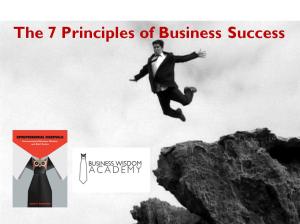
THE SEVEN KEY PRINCIPLES FOR BUSINESS SUCCESS – A Personal Belief Through Years of Practical Experience

Viewpoint by James D. Roumeliotis

Add to FacebookAdd to DiggAdd to Del.icio.usAdd to StumbleuponAdd to RedditAdd to BlinklistAdd to TwitterAdd to TechnoratiAdd to Yahoo BuzzAdd to Newsvine

7 Key Principles of Biz Success

Forget the cynicism. Businesses exist solely to make money while serving a need. Profitability is everything and cash is king. In public companies, shareholder return is considered essential. Operating from this mindset determines and measures whether the business in question is a success. If an entrepreneur is to increase the chances of triumph from the outset, he/she should consider seven key principles. These keys have been forged in the fire of my personal experience based on long-term practice and common sense seasoned with a touch of academia.

1) A VIABLE PRODUCT OR SERVICE WITH THE RIGHT BUSINESS MODEL AND A PASSIONATE PERSON BEHIND IT
It should fulfill a need, offer a benefit, be innovative and differentiate itself. It’s also imperative that the entrepreneur is passionate about the product/service, empowers his/her staff, as well as practices/conveys business ethics. To excel in the business, the entrepreneur must have the right mindset and attitude. This includes drive, perseverance, tenacity, and an undying belief in himself/herself and the value he/she adds. Must also be willing to embrace the concept that he/she takes complete ownership for his/her results. He/She can’t blame the marketplace, the economy or the employees for failure. In the end, it’s the entrepreneur making the decisions.

2) CAPITAL
Critical and can vary depending on the size of the undertaking. Start your capital search with a good business plan that shows investors and lenders your company’s potential.   Furthermore, Take advantage of any government loan program created for start-ups.
Expect to realistically invest about 30% of your own money based on the total value of the project. Last but not least, cash-flow is the lifeblood of your business if you’re going to sustain the operation financially.

3) MARKETING & SALES
Advertise, publicize, be first, different, daring and memorable. Deliver on those promises and constantly remain customer focused.

Sales, on the other hand, is part of the marketing function.  It includes business development and account  management. Sales is crucial to business because it is the bottom line, whereas marketing is about getting a product known. However, at the end of the day, it’s about the need for a constant stream of new business which brings in the necessary cash flow.

4) PEOPLE
Don’t simply HIRE well educated and experienced people but most importantly MOTIVATED, dedicated, coachable and with interpersonal skills. Moreover, make certain that the people you hire fit-in with your corporate culture. Your organization should also foster an atmosphere of Innovation and creativity through leadership. Work for staff should be meaningful rather  than a chore. These conditions can’t help but breed success. Implement an orientation workshop for new recruits and an occasional training program – invest in your key employees.

5) SYSTEMS – STRUCTURE
Consider publishing an “Operations Manual” and continuously enforce its procedures.  Without any structure, the chances of failure increases. Everyone should be on the same page and embrace best practices for quality results with consistency.

6) STRICT INTERNAL FINANCIAL CONTROLS & CASH FLOW
Watch them closely, borrow wisely and don’t overspend. It doesn’t matter how much you have coming in if most of it is going out. Watch your financial ratios and yields (where applicable). The success of your business is, in many ways, measured by the bottom line. Even if you hired a full-time accountant, you would still need to have a fundamental knowledge of accounting, how it works, and how to apply its basic principles in order to run a flourishing business.

7) CONTINUOUS IMPROVEMENT,  INNOVATION AND SUSTAINED GROWTH
This is by no means a one-time event but rather an on-going process.

Innovation encompasses offering distinguished and improved solutions which meet or exceed market requirements and expectations from your customers ‒ whether offering a desirable product or upgrading a service experience.

Add to FacebookAdd to DiggAdd to Del.icio.usAdd to StumbleuponAdd to RedditAdd to BlinklistAdd to TwitterAdd to TechnoratiAdd to Yahoo BuzzAdd to Newsvine

CONTACT ME to request for the FREE slide presentation on “The Seven Key Principles for Business Success.”

______________________________________________________

1 Comment

Filed under Business