Sharing an interview podcast I recently had, conducted by a food marketing expert on how I launched Artizan Fine Foods with my partner and what differentiates our products.

Sharing an interview podcast I recently had, conducted by a food marketing expert on how I launched Artizan Fine Foods with my partner and what differentiates our products.


Businesses of all sizes normally develop various pain points. A seasoned entrepreneur has actually made a list of 100. In the end, pain is a motivator for action to turn things around. However, the key is in how to tackle each one and in a timely manner. Better yet, how many of them are ever anticipated — and as a consequence solutions readily available? What is not anticipated are repercussions from poor decisions made or deceit deliberately caused with or without knowledge from company authorities. As a result, denial sets in from the top with accountability being dismissed.
Needless to say, chaos reigns within organizations which for many results in bleak outcomes. Within, there is a lack of communication, trust, transparency and loyalty. Not a sincere and astute way to operate a business.
By all appearances, there are plenty of executives who are simply results driven at the expense of their customers, employees as well as with their vendor relationships. Remarkably, most of those companies are publicly traded.
A survey conducted by JUST Capital’s of more than 40,000 U.S. participants and groups indicates that the nation’s largest corporations are “going in the wrong direction.”
Overall, only 41 percent of all Americans trust corporations “somewhat” or “a great deal,” while 50 percent of more conservative Americans trust corporations.
Source: http://justcapital.com/research
The cause of distrust among consumers can be rationalized due to corporations misleading the public as a whole, as well as their shareholders. Deliberate misleading information by food producers in regards to nutritional benefits and nickel-and-diming by airlines, hotels and banks are causes for frustration, suspicion and loathing.
Sectors notorious for constant price gouging coupled with despicable service include, but not limited to, a select number of pharmaceutical brands, banking/financial services, cellphone service providers, cable companies, large food brands and airlines. Too add salt to injury, in the U.S. and Canada, pointless aggressive lobbying efforts by various industries yield their influence by means of generous contributions to political parties. They are also infamous for spending a ludicrous amount of money producing sly ads and propaganda which go against consumer wishes. Consider the soda lobbyists who, according to a NY Times article, “made campaign contributions to local politicians and staged rallies, with help from allies like the Teamsters union and local bottling companies. To burnish its image, the industry donated $10 million to the Children’s Hospital of Philadelphia.” Sadly for consumers and the city of Philadelphia, the tactics worked. Similar outcomes occurred in New York City and San Francisco. In the end, the soda industry’s rubbish of an astonishingly high calibre, comes as it does from the same producers of fatty chips to the semi-literate masses. Shameful practices include the deceitful marketing of chemically-calibrated and engineered to simply taste good processed food products that are making its mainstream market obese, thus unhealthy.
In certain types of large scale B2B transactions, there can be scope for unscrupulous behavior. One or both parties are tempted to forego ethics in favor of making the deal. Such relationships inevitably end badly because they are either uncovered by authorities, as well as not conceived with trust or respect.
Then there are the occasional devious companies that will do what it takes in the name of revenue and profit ─ disregarding authorities, customers and everyone who takes their trust for granted. Volkswagen’s blatant rigging of emissions tests with over 11 million of its diesel cars sold globally, 482,000 of which are VW and Audi brand cars in the U.S., is an ideal case in point. As a result of its mischievousness, the company known for its hard core corporate culture caused a great deal of damage to the environment. Their supposed clean diesel models have been spewing up to 40 times more smog-causing nitrogen oxide pollution. The recall is one example of a deliberate act gone terribly awry for a brand which wholeheartedly masterminded it with self-admission. Rather than sacking the CEO Martin Winterkorn, under whose watch this scandal occurred, and depriving him of his golden parachute, the supervisory board allowed the septuagenarian, Mr. Winterkom, to conveniently step down and take home a lucrative compensation package.
contact this author for his pragmatic and practical approach.>
The term “Best practices” is not merely words but deeds. What is required is an efficient implementation of strategies, quality controls and delivering more than lip-service. Evidently, it is not easy, otherwise, many more businesses would be performing admirably.
To understand and penetrate the corporate governing structure and “culture”, you need look no further than the upper echelon of the hierarchical tree. It is where procedural decisions are shaped and executed. One would think and expect an entity’s leadership to head the enterprise by governing its long-term growth and sustained wealth. Conversely, there is a constant search for the “ideal” human resources. Recruited and fresh talent must resemble the leadership in tone and style. Call it the organization’s DNA. Exceptional organizations are good at these types of corporate strategies, thus strengthening performance effectively.
In the end, leadership ought to foresee and prevent any potential scandals, apply checks in balances, inspect what is expected, keep corporate structure layers to a minimum, and keep communication channels open.
In the ivory towers of public corporations, the CEO and board of directors have been programmed to put their stakeholders best interests above all else. Their mission is to do what it reasonably takes to deliver quarterly results ─ in other words, to focus on the short term rather than sow the seeds and do what is most beneficial for the future direction of the company ─ despite any short term pains. Savvy and considerate top management know better that customers and employees are the two key drivers of corporate success. The main principle is that if employees have a positive attitude, are passionate, well trained and competent, results will be reflected through positive customer experiences resulting in brand loyalty. Ultimately, the shareholders will reap the benefits through stock performance and generous dividend distributions.
Jack Ma, the founder and executive chairman of Alibaba Group, a family of highly successful Chinese Internet-based businesses, made a public statement which may have surprised the investment community. He publicly stated that, “Our customers come first, our employees second, and our shareholders third.” The highly regarded membership-only warehouse club COSTCO performs actions consistent with one’s claims as they too follow Jack Ma’s mantra. The impressive financial results year after year speak volumes as they retain the best intentions of their employees and customers.
It took Amazon quite long to finally earn a profit since its inception. Founder Jeff Bezos and his senior executive team dug in their heels despite outcries from many of their shareholders for continuously making large capital investments with no profits in sight. For a while, plenty of cash was spent for IT related infrastructure including Cloud computing and everything related to giving the company an edge over the competition. Customer service and the customer experience have been priority no. 1. In the end, shareholders who lingered learned that patience with their investment in Amazon is a virtue in the long run.
The attitude of the individuals in the boardroom had better be that if investors are impatient and eager for quick monetary results, they can take their money and invest it elsewhere.
A well-oiled operation should consistently head steadily on its current course regardless of any obstacles that get in its way.
Research by the U.S. Bureau of Labor Statistics reveals that nearly six out of 10 businesses shut down within the first four years of operation.
To be a successful entrepreneur is not an effortless task. It takes plenty of sacrifice. A new generation of young entrepreneurs think the road is smooth and a fast track to easy wealth. Not everyone will become Mark Zuckerberg. Obstacles and sacrifice are part of the deal. Harnessing opportunity and overcoming challenges on a daily basis to top the competition is constant work. These conditions are true no matter what the sector of business engagement or company size.
Telltale signs of weak organizations can be traced to inept leadership. The following points highlight the deficiencies:
In the final analysis
In large corporations, the Boards should be held more accountable by paying closer attention to the behavior and actions in the C-suite ‒ thus reacting before things go awry.
The top executive’s job is to operate a business that adds value by means of the goods and services it provides to customers.
The way to solve an organizational problem is to confront the structural issues with a moral sense of purpose and ethics. Higher morale generates higher profits – though occasionally other priorities undermine that objective, for example, self-serving behavior by certain executives or chasing short-term selfish objectives in search of rapid market share, profits and self-interests before people. Monsanto’s executive conduct would make for a marvelous case study in this regard.
According to marketing maven Seth Godin, “It’s the flameouts and the scams that get all the publicity, but it’s the long-term commitment that pays off.”
Wish list of best practices should include but not limited to:
In the end, what you manage and how you manage it is what you get — methodical, sustained growth with patience and lack of greed.
_____________________________________________________
Request your TWO FREE chapters of this popular book with no obligation.
Viewpoint by James D. Roumeliotis

Prior to taking a plunge in your start-up, you conduct thorough research, plan meticulously, execute strategy flawlessly ‒ but over time, you barely survive, or worst yet, fail altogether. What gives?
According to statistics, as the latest available numbers from the two U.S. government statistical agencies responsible for providing data about new businesses illustrate, The Census Bureau and the Bureau of Labor Statistics, five years after new establishments were founded (1995, 2000 and 2005 respectively), 50%, 49 and 47 percent of them (correspondingly) were still in operation.
Merely reading a business book, this article, or attending a well-regarded entrepreneurship course/program is no guarantee of success in increasing one’s odds of business success. It takes diligent implementation of a viable business plan, focus, determination, consistent and well thought out action, as well as an obsession with the customer, amongst other traits and approaches. Management of a business is not a science, it’s a practice.
SME/SMB business owners optimistic despite odds of failure
A new, independent survey has found that small and mid-size business owners share several distinct attributes that help them live their passions while adapting to the shifting economic landscape.
Commissioned by Deluxe Corp. a publicly traded company and leading provider of marketing services and business products for small businesses and financial institutions, the study surveyed more than 1,000 SMB owners around the U.S. The results showed 86 percent of the respondents believe they can do anything they set their minds to, with 77 percent also stating they would rather learn from failure instead of never trying at all.
Based on the results, it’s no wonder entrepreneurs are known as risk averse and tenacious ‒ or as some would light-heartedly state, “We’re going to succeed because they’re crazy enough to think they can.”
Pitfalls of business failure
On the whole, businesses fail due to its owners’ lack of fundamental business knowledge. Needless to say, failed businesses did not operate the same way as those that succeed. The following are oversights and inaction responsible for their demise.
“Why does your organization exist? Why does it do the things it does? Why do customers really buy from one company or another? Why are people loyal to some leaders, but not others? Starting with “why” works in big business and small business, in the non-profit world and in politics. Those who start with “why” never manipulate, they inspire. And the people who follow them don’t do so because they have to; they follow because they want to.”
7 principles for business success: Avoid being a failed business statistic
If an entrepreneur is resolute enough to increase the chances of triumph from the outset, he/she should consider several key principles. These seven beliefs have been forged through my personal experiences, those of others I have either researched/interviewed and/or advised, as well as based on long-term practice and common sense seasoned with a touch of academia.
1) A Viable Product or Service with the Right Business Model and a Passionate Person Behind it
It should fulfill a need, offer a benefit, be innovative and differentiate itself. It’s also imperative that the entrepreneur is passionate about the product/service, empowers his/her staff, as well as practices/conveys business ethics. To excel in the business, the entrepreneur must have the right mindset and attitude. This includes drive, perseverance, tenacity, and an undying belief in himself/herself and the value he/she adds.
2) Adequate Capital
Critical and can vary depending on the size of the undertaking. Start your capital search with a good business plan that shows investors and lenders your company’s potential. Expect to realistically invest about 30% of your own money based on the total value of the project. Last but not least, cash-flow is the lifeblood of your business if you’re going to sustain the operation financially.
3) Marketing, Sales and Customer Driven
Advertise, publicize, differentiate, ‒ and be compelling, as well as memorable with your messages. Deliver on those promises and constantly remain customer focused. Sales, on the other hand, is part of the marketing function. It includes business development and account management. Sales is crucial to business because it is the bottom line, whereas marketing is about getting a product known and the customer keeps your business alive.
4) People
Don’t simply HIRE well educated and experienced people but most importantly MOTIVATED, dedicated, coachable and with interpersonal skills. Moreover, make certain that the people you hire fit-in with your corporate culture.
5) Systems and Structure in Place
Every business requires a disciplined way of conducting itself. This way everyone is on the same page. Consider publishing an “operations manual” and continuously enforce its procedures. However, at the same time, it should include an element of flexibility to avert stifling the organization. Without any structure, the chances of failure increases.
6) Strict Internal Financial Controls and Adequate Cash Flow
Finances should be closely supervised, borrowing wisely and avoiding overspending. Watch your financial ratios and yields (where applicable). The success of your business is, in many ways, measured by the bottom line. Even if you hired a full-time accountant, you would still need to have a
fundamental knowledge of accounting, how it works, and how to apply its basic principles in order to run a flourishing business. Once again, “cash flow” Cash flow is of vital importance to the health of a business. One saying is: “revenue is vanity, cash flow is sanity, but cash is king”.
7) Continuous Improvement, Innovation and Sustained Growth
This is by no means a one-time event but rather an on-going process. Innovation encompasses offering distinguished and improved solutions which meet or exceed market requirements and expectations from your customers ‒ whether offering a desirable product or upgrading a service experience.
Keep in consideration ‒ govern oneself accordingly
Entrepreneurs, and inventors alike, may be quite well versed with the products and/or services offered, but not necessarily with running their business including a bucket list of daily administrative tasks. Most notably, sales, marketing and finance/accounting undertakings. This is where honest consideration should be given in either bringing in a partner to complement the entrepreneur’s weaknesses or an external adviser and/or mentor to guide him/her. A sounding board should not be dismissed as an advantage solely for larger organizations. Seeking professional help is an important way to avoid or plan for business challenges.
Prior to drafting a business plan as the roadmap, which assists one in avoiding the pitfalls of running a business, plotting a business model should be considered as a prelude to the business plan. The idiom “putting the cart before the horse” clearly reminds us of this erroneous and common approach ‒ in this case, the business plan preceding the business model or lack thereof. The business model includes the components and functions of the business, as well as the revenues it generates and the expenses it incurs. It is part of the business strategy.
Typically, small businesses with inept ownership usually fail in the first year or two, but even companies in their growth stage can stumble badly when they outgrow the capabilities of the founding team. Research by the U.S. Bureau of Labor Statistics demonstrates that nearly 6 out of 10 businesses shut down within the first 4 years of operation.
Enterprises spanning a wide array of industries, have earned distinction as “well-” or “best-” managed” by demonstrating business excellence through a meticulous and independent process that evaluates their management abilities and practices – by focusing on innovation, continuous training, brainstorming and caring for their employees’ well-being – as well as investing in meeting the needs of their clients. Marketing maven and renowned author, Seth Godin, succinctly puts it this way:
“Many entrepreneurs use an innovation to make an impact, but the hard part, the part that we’re rewarded for, is engaging with the user, the audience, the market. Bringing something to people who didn’t think they wanted it, know about it or initially welcome it, and make a difference.”
In the end, small businesses are started and managed by entrepreneurs, who with all their best intentions, are highly motivated but typically lack training in standard business practices. Thus, entrepreneurs with little more than a great idea, limited funds and a lack of management/operations skills and experience are prone to failure without the resources that can sustain and help grow their business.
___________________________________
Request your TWO FREE chapters of this popular book with no obligation.

How often do we hear employers, of all sizes, complaining that there is a dire shortage of good talent out there? What should we really make of this? Is there anyone to blame – everyone but the employers themselves? Consider the daily hiring procedures and habits of most employers to realize who is at fault for the hiring dilemma. Engaging prospective employees by utilizing mainly the human resources staff and/or relying solely on a plethora of job boards, automated hiring/”big data” or software to scan and screen-out resumes is not only irresponsible but rather a wasteful practice, totally impersonal, as well as a thoughtless and a lazy way to bring, supposed, qualified people on board.
Through third parties and automated systems, how is a hiring manager going to discover candidates who bring more than just skills to the table – ones who also bring about an ideal attitude and character? Think soft skills/emotional IQ. The job of hiring should be conducted by none other than the person to whom the potential new employee will be reporting to – or rather be assigned with tasks.
If there is a list of ideal and practical methods of properly hiring employees, which I fully subscribe to, then you ought to read the article “How To Hire: 8 stunning tips“ in Nick Corcodilos’s blog “Ask The Headhunter®.”
Here is the link: http://www.asktheheadhunter.com/10693/how-to-hire

Recruiting done properly and effectively is not an occasional task but an on-going process. Potential candidates can be discovered anywhere. Even if the hiring manager is not actively seeking a candidate, he or she should be doing so proactively by keeping his or her ears and eyes open at all time and literally anywhere – whether during networking, social activities, or during his or her time off. I am aware of two such cases; whereby a business owner and a recruiter, respectively, both came across their potential candidate while dining at a restaurant. In either case, they were impressed when they overheard an individual, at the table beside them, talking about his/her career goals and aspirations. The pleasant personality and discussion drew them in impressive ways that the hiring managers could not help but engage with this person. In the end, the eavesdroppers extended the individual an invitation for a job interview. Eventually, they were hired by their respective employers.
Request your TWO FREE chapters of this popular book with no obligation.
Filed under Business, business management, hiring, hiring managers, management, recruiting

For those who are considering venturing into the recession proof food production sector, though previous experience in that domain would be a valuable asset, if you have the passion, discipline, adequate funds, a viable product, and a high caliber team (with individuals that bring sales, marketing and finance expertise along with CPG know-how), your rate of success will undoubtedly increase. However, in practice there are no guarantees of triumph regardless of your resources. Blame is not entirely on the entrepreneur but rather on circumstances beyond one’s control. As such, there is a way to increase positive outcomes throughout the start-up journey by being prepared and anticipating potential hurdles in advance. This entails implementing a feasible strategy, remaining resilient along the way and applying a practical step-by-step process as the one outlined in this article. Consider it as your guide which was developed as a result of painstaking experiences during 18 months which ultimately led to launching a gluten-free and health snack from the ground-up.
What it takes to make it to market
Everyone needs to eat to survive
Starting a business is a challenge with statistically high failure rates during the initial five years ─ let alone starting a food production business. Statistics on this sector show promising growth. However, the food sector, especially in the health category, has tremendous opportunity for brands which offer snacks, ready to eat or easy to prepare meals which are tasty, allergen-free and with all natural ingredients – especially plant based.
The biggest challenges in the CPG (Consumer Packaged Goods) sector are the need for a large sum of capital (most notably if you plan on opening your own facility), a focus on research & development, scaling the product from the kitchen to manufacturing, as well as executing a plan for going to market. It is also an industry with government safety regulation requirements which the food entrepreneur should be quite familiar with and comply without compromise.
Despite the industry’s inherent challenges, it is still worth considering this route as there is plenty of room to increase one’s prosperity while also benefiting the consumer with nourishment. Although there is complexity involved, it is recommended that one starts small, hires a contract manufacturer for production. The moment sales begin to increase dramatically along with cash flow, a that juncture, in-house manufacturing may be a viable option.
As for risks, choose to take the “calculated” type as in “planned with forethought.” Anticipate problems and be prepared with viable solutions. Finally, watch those margins carefully.
______________
According to Mintel, a research firm, these are the food market categories.
I would also add:
____________________
Request your TWO FREE chapters of this popular book with no obligation.
by James D. Roumeliotis

Prior to his sudden demise, I always had quite the fondness and following for Prince, “The Artist.” Ever since I discovered his music in the late 70s, what never seize to amaze me since was his eclectic work (comprised of dance, funk and rock tunes), vocal range and the method in which he always managed to integrate it all seamlessly during his formidable stage presence.
However, what many may not have been aware of was his show business acumen. Prince built and sustained his personal brand along with the resources he exploited which comprised of his musical entertainment enterprise.
What I have learned from this beloved and prematurely departed artist are three lessons which any business can use as a takeaway for implementation. They are as follows:
1) Stray from the ordinary and remain relentlessly competitive
“The Artist” was widely acclaimed by his fans, the media and fellow musicians as one of the most influential and creative musicians of his generation. He seemingly left behind an impressive music legacy. Unlike most artists, Prince was a prolific songwriter, multi-instrumentalist, sang in a variety of vocals, produced his work, as well as displayed dance and theatrical antics on stage. Must we forget that he was also an actor ─ most notably in “Purple Rain” along with performances in four other movies including on television. Moreover, he wrote songs for and produced work for other musical acts including some he impacted and/or for whom he acted as their mentor and coach.
Prince also knew how to outdo his competition by standing out with his artistic performances including the eccentric outfits he sported along with his leaping dance acts he displayed with his platform shoes ─ as he only stood at 5’2”/1.58m. Some of his singles, which eventually turned into big hits, were purposely targeted at some of his rivals.
An exemplary display of Prince’s unique and memorable performance was a video, recorded at the 2004 Rock and Roll Hall of Fame induction ceremony. The illustrious artists playing the Beatles’ “While My Guitar Gently Weeps.” include George Harrison’s son Dhani, along with old band-mates and collaborators Jeff Lynne, Tom Petty and Steve Winwood. However, most striking among this band, who stood slightly apart from the rest while they played ordinarily, was Prince. Despite his small frame and wearing a dark suit with a red shirt, a matching derby hat, and staying on the sidelines for the first 3:27 minutes or so (in the YouTube recorded video), he suddenly steals the show with his passionate guitar solo. As the song ends, Prince abruptly takes off his guitar, tosses it in the air and then disappears off stage. That was probably the most memorable part of the video from my perspective. Many more who watched it share the same sentiment.
2) Branding, image and reputation are your equity
As with traditional businesses, Prince had created a personal persona – where the brand and performer were synonymous. He created a logo dubbed the “The love symbol” ─ one that blended the symbols for male and female which was instantly recognizable. It was also the shape of his customized guitars. Prince even owned a signature color in the mind of his followers – purple. His occasional provocative lyrics, seductive singing, dramatic performances and distinctive album covers all depicted a unique style as an icon and as a showman of his personal brand.
As one Twitterer remarked in his Tweet following Prince’s death, “Prince built a brand around his music and his genius before content marketing and personal branding became a thing.” Another stated, “Like Bowie, Prince reminded us that it’s not just OK to be weird—it’s cool to be weird.”
The moral of this narrative is that as a business, follow what Prince did ─ by working on building your brand image consistently, by establishing unique features with your products/services that distinguish them from the competition, and by being true to yourself, as well as by what you truly stand for.
3) Become vertically integrated
Prince was more than an artist, he was one who only entrusted himself with songwriting, arranging, producing, naturally performing his own music, as well as distributing it through his own label (NPG Records and Paisley Park Records before it). To do so, he built a $10 million state-of-the-art complex in a suburb of Minneapolis, Minnesota which he named Paisley Park Studios. That said, he became his own vertically integrated corporation. This was, after all, a multi-talented musical artist who believed in taking control of his own destiny and in return, earning the maximum revenue and profits rather than giving much of it away – most notably to a record label. He considered the role of record labels exploitation and slavery. He was a fierce advocate for artist rights and independence and in he had standoff with Warner Bros., his label at the time. In protest, Prince removed his name from his album releases and changed his name to a symbol. He also styled himself as “The Artist Formerly Known as Prince.” Furthermore, during a legal battle with Warner Bros., he scrawled the word “Slave” on his face during his appearances and performances.
The significance with this illustration is that a business with adequate capital, resources and expertise ought to consider amalgamating most or all of the processes under its own umbrella. A such, quality control and improved profits are now controlled by the business itself.

Paisley Park Studios
A final point of intrigue
On a noteworthy footnote, in his 37 years as an artist ─ and unlike many with his fame, he kept himself out of the negative spotlight. He never plagiarized a fellow artist’s work, never had to hire a ghost writer, and neither involved in a scandal which would drag him to the courts. In the end, he was capable of playing more or less 20 instruments admirably and having earned 19 Platinum albums, 6 gold albums, along with a double diamond record for his Purple Rain album which sold 21 million copies. Impressive for a personal brand to say the least.
________________________________________
Request your TWO FREE chapters of this popular book with no obligation.
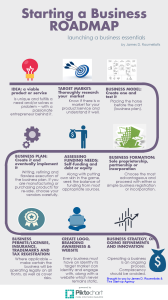
Starting a business from the bottom up requires discipline, decisiveness, a roadmap along with structure from the get-go.
There is a plethora of advice on entrepreneurship and on launching a business out there but very little substance on a universal step-by-step guide or a turn-key resource.
Prior to taking a plunge in your start-up, a thorough research should be conducted, a meticulously plan set in place, and implementation performed flawlessly. Nothing should be taken for granted.
The following link takes you to a step-by step start-up roadmap infographic.
https://magic.piktochart.com/embed/4766874-starting-a-business-roadmap
Request your TWO FREE chapters of this popular book with no obligation.
Entrepreneurship is not for the insecure. It takes a good idea, a burning desire to execute it, and the right personal characteristics including:
– At least some fundamental business knowledge
– Passion
– Drive
– Resilience
– Perseverance
– Persistence
– Curiosity and and open-mindedness
– Willing to take calculated risks
CLICK HERE for a collection of images that speak for themselves pertaining to entrepreneurship and the entrepreneur.
__________________________________________
Learn the significance of all of the above images BUT with the TEXT version in this book.
Learn how to start or expand a business with free courses at

Viewpoint by James D. Roumeliotis
Forget the cynicism. Businesses exist solely to make money while serving a need. Profitability is everything and cash is king. In public companies, shareholder return is considered essential. Operating from this mindset determines and measures whether the business in question is a success. If an entrepreneur is to increase the chances of triumph from the outset, he/she should consider seven key principles. These keys have been forged in the fire of my personal experience based on long-term practice and common sense seasoned with a touch of academia.
1) A VIABLE PRODUCT OR SERVICE WITH THE RIGHT BUSINESS MODEL AND A PASSIONATE PERSON BEHIND IT
It should fulfill a need, offer a benefit, be innovative and differentiate itself. It’s also imperative that the entrepreneur is passionate about the product/service, empowers his/her staff, as well as practices/conveys business ethics. To excel in the business, the entrepreneur must have the right mindset and attitude. This includes drive, perseverance, tenacity, and an undying belief in himself/herself and the value he/she adds. Must also be willing to embrace the concept that he/she takes complete ownership for his/her results. He/She can’t blame the marketplace, the economy or the employees for failure. In the end, it’s the entrepreneur making the decisions.
2) CAPITAL
Critical and can vary depending on the size of the undertaking. Start your capital search with a good business plan that shows investors and lenders your company’s potential. Furthermore, Take advantage of any government loan program created for start-ups.
Expect to realistically invest about 30% of your own money based on the total value of the project. Last but not least, cash-flow is the lifeblood of your business if you’re going to sustain the operation financially.
3) MARKETING & SALES
Advertise, publicize, be first, different, daring and memorable. Deliver on those promises and constantly remain customer focused.
Sales, on the other hand, is part of the marketing function. It includes business development and account management. Sales is crucial to business because it is the bottom line, whereas marketing is about getting a product known. However, at the end of the day, it’s about the need for a constant stream of new business which brings in the necessary cash flow.
4) PEOPLE
Don’t simply HIRE well educated and experienced people but most importantly MOTIVATED, dedicated, coachable and with interpersonal skills. Moreover, make certain that the people you hire fit-in with your corporate culture. Your organization should also foster an atmosphere of Innovation and creativity through leadership. Work for staff should be meaningful rather than a chore. These conditions can’t help but breed success. Implement an orientation workshop for new recruits and an occasional training program – invest in your key employees.
5) SYSTEMS – STRUCTURE
Consider publishing an “Operations Manual” and continuously enforce its procedures. Without any structure, the chances of failure increases. Everyone should be on the same page and embrace best practices for quality results with consistency.
6) STRICT INTERNAL FINANCIAL CONTROLS & CASH FLOW
Watch them closely, borrow wisely and don’t overspend. It doesn’t matter how much you have coming in if most of it is going out. Watch your financial ratios and yields (where applicable). The success of your business is, in many ways, measured by the bottom line. Even if you hired a full-time accountant, you would still need to have a fundamental knowledge of accounting, how it works, and how to apply its basic principles in order to run a flourishing business.
7) CONTINUOUS IMPROVEMENT, INNOVATION AND SUSTAINED GROWTH
This is by no means a one-time event but rather an on-going process.
Innovation encompasses offering distinguished and improved solutions which meet or exceed market requirements and expectations from your customers ‒ whether offering a desirable product or upgrading a service experience.
______________________________________________________
Request your TWO FREE chapters of this popular book with no obligation.
Learn how to start or expand a business with free courses at